
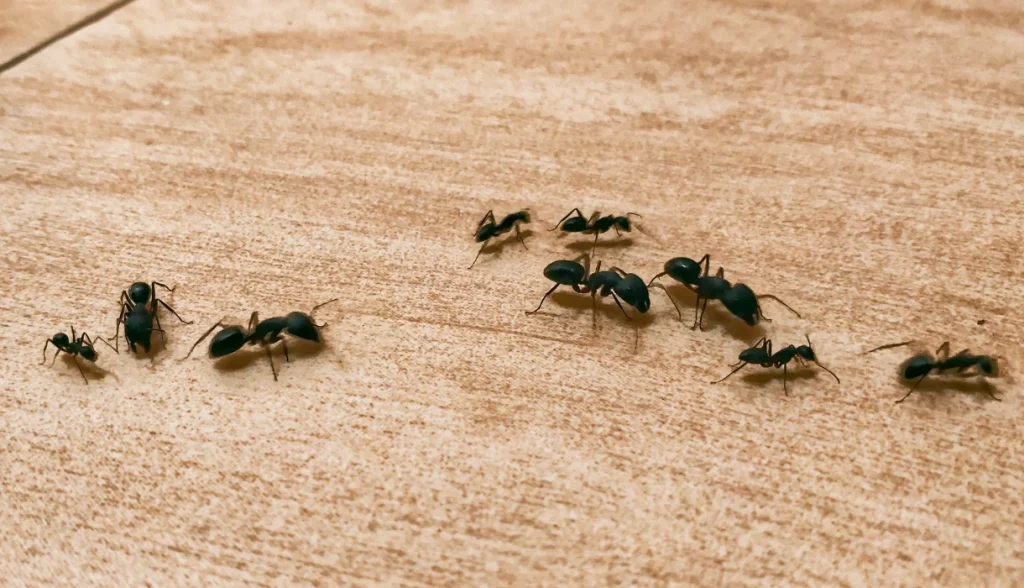
A trail of tiny ants beside the kitchen sink is one kind of problem. Large black ants showing up near damp trim can point somewhere else entirely. Learning the common types of ants in Missouri helps you tell those situations apart before you start cleaning, sealing gaps, or trying to find a nest.
Color can narrow the possibilities, but it rarely settles an identification by itself. Size, trail patterns, moisture, nesting areas, and the exact place where workers keep appearing usually tell you more.
Homeowners around St. Louis, Springfield, and other Missouri communities may find ants in kitchens, bathrooms, basements, lawns, patios, trees, mulch beds, and structural wood. Some species live mainly outdoors. Others regularly forage inside or establish colonies close enough to a house that workers keep returning. A useful identification starts with a simple question: where are the ants coming from?
Common Types of Ants in Missouri
The types of ants in Missouri that homeowners notice around houses vary widely in size and nesting behavior. A very small ant crossing a countertop shouldn’t be approached the same way as a large worker coming from a wooden window frame.
| Type of Ant | Typical Worker Size | Common Clue | Where You May Find Them |
| Carpenter ants | About 1/4 to 1/2 inch | Large workers associated with wood | Trees, decks, wall voids, damp wood |
| Odorous house ants | About 1/8 inch | Small workers forming steady trails | Kitchens, bathrooms, foundations |
| Pavement ants | About 1/8 inch | Activity around concrete cracks | Driveways, patios, slabs, foundations |
| Acrobat ants | About 1/8 inch | Distinctive rear body shape | Trees, damaged wood, structural spaces |
| Little black ants | Around 1/16 inch | Extremely small dark workers | Cabinets, baseboards, kitchens |
| Field ants | Often 1/4 inch or larger | Outdoor mounds | Lawns, open soil, landscaping |
| Citronella ants | Roughly 3/16 to 1/4 inch | Yellow or yellow-brown workers | Soil, foundations, beneath slabs |
Carpenter Ants
Carpenter ants stand out because their workers can be much larger than the tiny ants commonly seen around food. Many are dark-colored, although color varies enough that a large black ant should be treated as a clue rather than a final identification.
These ants excavate wood to create nesting galleries. They don’t consume wood the way termites do. Damp or deteriorated wood can provide favorable nesting conditions, while outdoor colonies may occupy trees, stumps, logs, decks, fences, and other wooden areas.
Workers can travel away from the main colony while foraging, so the room where you find an ant may not contain the nest. According to the NC State Extension, these trails can be up to 300 feet away when extensive foraging is done.
Odorous House Ants
Odorous house ants are much smaller and often become noticeable because of their trails. Workers can move through narrow openings near windows, siding, trim, and utility penetrations before reaching food or moisture indoors.
Kitchens and bathrooms are common places to notice activity. Crumbs, sweet residue, plumbing moisture, and food stored in accessible containers can keep an ant trail active.
Their name refers to an odor produced when workers are crushed. Smell may support an identification, but size, location, and trail behavior are more dependable clues for a homeowner.
Pavement Ants
Pavement ants commonly nest in soil beneath or beside sidewalks, driveways, patios, slabs, and foundation edges. You may see workers entering a crack or notice small amounts of displaced soil near concrete.
The colony can remain outdoors even when workers are appearing inside. Ants traveling along a foundation edge or basement floor may simply be following a route from a nearby nest while searching for food.
Acrobat Ants
Acrobat ants sometimes appear around trees, cavities, damaged wood, insulation, and structural spaces. Their rear body section has a distinctive shape, and workers may raise it when disturbed.
Because they can occur near wood, homeowners sometimes confuse them with carpenter ants. Their smaller size provides a useful way to narrow the identification.
Little Black Ants, Field Ants, and Citronella Ants
Little black ants are among the smallest ants that may enter a house. Their size lets them use tiny gaps around cabinets, windows, trim, and baseboards, which can make the source of an indoor trail difficult to spot.
Field ants are more closely tied to lawns and outdoor soil. A visible mound in the yard may represent a healthy outdoor colony without indicating an infestation inside the home.
Citronella ants are easier to separate by color because workers are usually yellow to yellow-brown. They spend much of their time underground, although winged ants may become noticeable around foundations or lower parts of a structure.
How to Identify Ants Around Your Home
Good ant identification in Missouri starts with observation. Before wiping away a trail, watch where workers are moving and where they disappear. A crack beside the patio suggests something different from activity coming out of damp trim.
Try to estimate the ants’ size and take a close photo if you can. A ruler, coin, or another familiar object in the frame can make the picture more useful later.
| Identification Clue | What It Can Tell You |
| Worker size | Helps separate tiny household ants from larger species |
| Exact location | Points toward soil, pavement, wood, or structural nesting |
| Ant trails | May reveal the route between a colony and food |
| Moisture | Can explain activity near plumbing or damp wood |
| Soil or debris | May show where ants are excavating |
| Nearby wood | Makes wood-associated species worth checking |
| Wings | May indicate reproductive ants or termites |
Follow the Activity Before Cleaning It Up
An ant trail can answer questions that individual workers can’t. Watch whether ants are heading toward food, disappearing beneath a baseboard, entering through a window gap, or moving back outside.
The same approach works in the yard. Look around foundation cracks, tree bases, old stumps, deck supports, mulch beds, and utility entry points if the trail continues outside.
Check Food, Water, and Moisture
Ants in the house aren’t always there because of visible crumbs. Pet food, residue beneath appliances, recycling containers, moisture under a sink, or condensation near a window can support repeated activity.
If ants keep appearing after food has been cleaned up, pay closer attention to water and structural conditions. A damp area can be more informative than the counter where the workers were first noticed.
Flying Ants vs. Termites in Missouri
Winged Missouri ants are easy to mistake for termites at a quick glance. Both groups produce reproductive insects with wings, and both may suddenly appear in noticeable numbers.
A flying ant isn’t a separate ant species. It’s a reproductive member of a colony. Looking closely at the antennae, waist, and wings can help separate ants from termite swarmers.
| Feature | Winged Ant | Termite Swarmer |
| Antennae | Elbowed | Straighter |
| Waist | Narrow and constricted | Broad through the middle |
| Wings | Front pair usually larger | Two pairs similar in length |
| Body shape | Clearly divided into sections | More uniform through the middle |
The distinction matters because termites and ants behave differently and require different inspection strategies. Large winged ants may be associated with a carpenter ant colony, while termite swarmers point toward another structural pest issue.
The Missouri Department of Conservation provides Missouri-specific background on ant behavior and their place in the state’s ecosystem. Many colonies found outdoors are simply part of that environment rather than evidence of an indoor problem. If the insects are too small to identify clearly, collect a specimen or take a close photo instead of relying on color alone.
Why Ants Keep Showing Up Around Missouri Homes
Ants in Missouri homes usually appear because workers have found food, water, shelter, or a useful route through the structure. The source may be obvious, such as an open food container, or hidden beneath a sink, behind an appliance, or outside along the foundation.
Even a clean kitchen can offer something useful to ants. A pet dish, grease beneath a stove, moisture around plumbing, or a small amount of residue inside a cabinet may keep workers returning.
Food and Moisture Sources
Follow an active trail before removing it. Workers may lead you toward a pantry shelf, pet feeding area, sink, window, or narrow gap beside the countertop.
Moisture can be just as useful as food. Check around plumbing, basement dampness, condensation, and wood that stays wet after rain or leaks.
Outdoor Nests and Entry Points
Many common ants in Missouri begin their activity outdoors. Pavement ants may nest beneath concrete, while carpenter ants can occupy trees, stumps, decks, or other wood around the property.
Foundation cracks, gaps around windows and doors, utility penetrations, vegetation touching the house, and mulch against the foundation can all provide protected travel routes. The Environmental Protection Agency (EPA) Integrated Pest Management principles support identifying the pest, monitoring activity, and correcting conditions that contribute to the problem instead of focusing only on insects that are visible.
When an Ant Problem Needs a Closer Inspection
An ant problem in Missouri deserves a closer look when activity keeps returning from the same place. Large workers around wood, winged ants indoors, repeated trails through wall gaps, or activity in several rooms can all make the source harder to identify without an inspection.
Signs of carpenter ants are especially worth investigating when large ants repeatedly appear around damp or damaged wood. Visible workers tell you that ants are active, but they don’t tell you whether the colony is inside the structure, in a nearby tree, or somewhere else on the property.
The same applies to tiny ants that keep returning after food sources have been removed. Their ant nest may sit outdoors, beneath concrete, inside a structural space, or in another protected location that is difficult to trace from the visible trail.
Professional ant control becomes useful when identification or nest location remains unclear. A technician can compare the insects with moisture conditions, structural openings, nearby landscaping, wood, pavement, and other evidence before deciding what should be addressed.
Choosing the Right Ant Control Approach for Your Missouri Home
The types of ants in Missouri don’t share one nesting pattern or one reason for entering a house. Pavement ants beneath a slab, tiny ants following a kitchen trail, and carpenter ants associated with wood each point toward different conditions that need to be investigated.
Start by identifying what you can. Note the ants’ size, location, trail pattern, nearby moisture, wood, soil, and any obvious entry points. If the activity continues or the source stays hidden, an inspection can answer questions that treating visible workers won’t.
Holper’s Pest & Animal Solutions uses an Integrated Pest Management approach and sends a trained technician to inspect the property. If ants keep returning, you suspect carpenter ants, or you can’t locate the source, contact Holper’s Pest & Animal Solutions to schedule an inspection and get a recommendation based on the conditions at your home.